
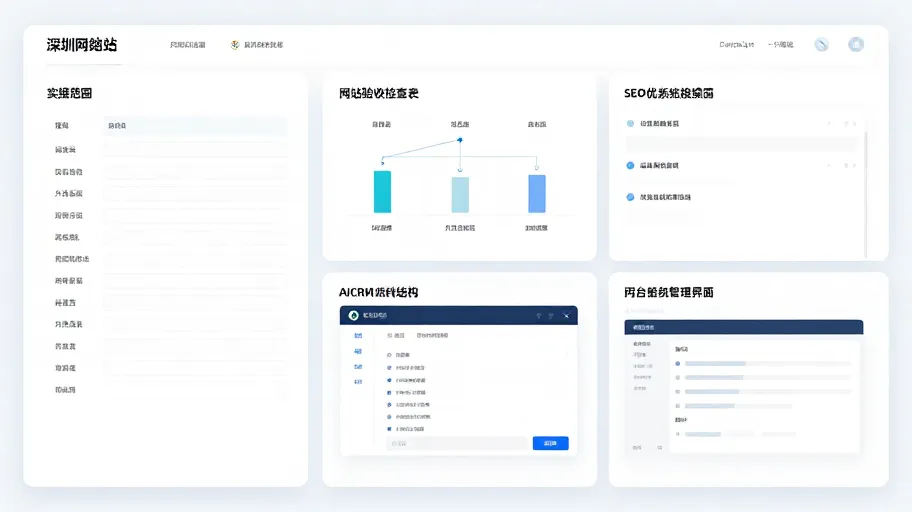
The most common failure point in Shenzhen website development projects lies not in design or coding, but in failing to clearly define requirements, scope, and acceptance criteria before starting. Many companies begin comparing quotes with just the idea of "building a corporate website," only to discover after launch that their foreign trade inquiry forms are difficult to use, the backend lacks maintenance expertise, or the SEO structure was never planned. This article provides a decision-making framework and checklist you can directly apply, following the sequence of "clarify first, define scope next, and verify at the end."

Is your website still just an electronic business card? Truly valuable design turns every visitor into a potential customer. We dissected the practical strategies of Shenzhen’s leading companies to show you how a great website can directly drive revenue.
When considering GEO optimization, the first questions to address are not "who should do it," but three preliminary ones: Do we really need it? What scope should we aim for? And what criteria will we use for acceptance? Here's a straightforward method to make this judgment: If your customer acquisition increasingly relies on the visibility of AI search and conversational entry points, and existing SEO methods can no longer cover these new scenarios, then GEO optimization is worth initiating. Conversely, if most of your traffic still comes from traditional search engines and established customer channels, you might start with a small-scale validation before deciding on the scale of investment.

Traditional SEO and CRM are failing. User intent changes in milliseconds, and if your response is delayed by just 5 minutes, you'll lose 85% of your leads. Truly effective growth means anticipating needs ahead of time—by optimizing GEO closed loops and integrating AI CRM, turning every search into an opportunity for proactive outreach.

Building an independent site in Shenzhen is becoming a core pathway for brands expanding overseas. By mastering reasonable budgets and key technologies, you can reduce operational friction costs by 30% and improve user conversion rates. Next, we’ll break down actual costs, technical logic, and implementation timelines.

‘Free website building’ sounds appealing, but most platforms make money through commissions and feature walls. We’ve dissected the real cost structure to show you how to launch with zero cost from day one and continue expanding.
Is your independent site still running on a template? Delayed orders, stalled conversion rates, and a lack of brand recognition in international markets—these aren’t operational issues; they’re limitations imposed by the system’s ceiling. We’ve helped 37 Shenzhen-based companies complete migrations, recovering costs in an average of 14 months.
Free traffic shouldn’t be a one-off visit. By integrating GEO AI CRM, businesses can transform every click into an actionable customer asset, automating traffic capture and driving continuous conversion leaps.

Stop assuming free SEO means randomly writing articles. True zero-cost growth relies on precise strategies and systematic execution. What you save isn’t just ad spend—it’s also the customer-acquisition capital for the next three years.

Shenzhen website construction is saying goodbye to sky-high bills. True cost-effectiveness comes from architectural innovation rather than price-cutting competition. See how leading companies maximize ROI through automation, data-driven approaches, and modularity.

90% of Shenzhen foreign trade websites die due to slow loading speeds. We’ve dissected the true logic behind efficient website construction: technical architecture determines conversion rates, not page aesthetics. Here’s a replicable, practical roadmap.

