
Conclusion First: Before deciding whether to implement GEO optimization, consider three key questions: Are more of your potential customers increasingly using AI-powered Q&A tools to find suppliers? Can your existing SEO content be directly cited as answers by these AI tools? Do you have the capability to consistently produce structured, verifiable content? If one or two of these questions are answered positively, GEO optimization is worth including in your planning; if all three are negative, focus on strengthening your foundational content and independent site capabilities first.
Before users even speak, the system already anticipates their needs—through the deep integration of a GEO optimization closed loop and an intelligent customer management system, enterprises are making the leap from passive response to proactive anticipation. Here’s a replicable practical roadmap.
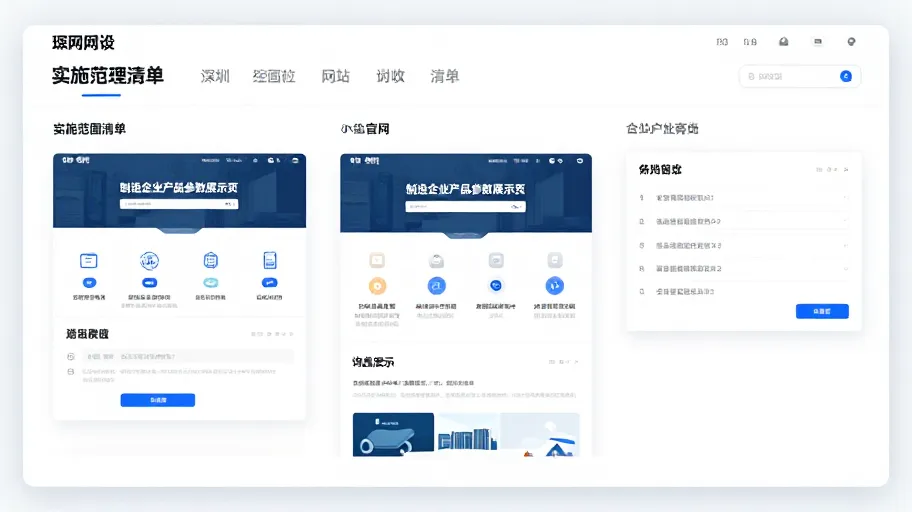
The success or failure of a Shenzhen website development project often hinges not on the technology itself, but on whether the requirements, scope, and acceptance criteria are clearly defined before starting. For small and medium-sized enterprises, manufacturing companies, and foreign trade businesses in Shenzhen and the Greater Bay Area, the most practical approach is to first use a decision-making framework to determine "what business problems this website aims to solve," then employ an execution checklist to constrain the vendor's implementation scope, and finally utilize an acceptance checklist to ensure delivery quality. This article unfolds in that order, helping you maintain clear documentation throughout the process.

Is your traditional CRM still just keeping track of transactions? AI-powered intelligent customer relationship management systems can now predict your customers’ next moves. From identifying high-value clients to automatically intercepting churn risks, discover how leading companies use data to outpace their competitors.

Template sites boast conversion rates below 2%, while custom-built independent sites easily exceed 5%. Shenzhen independent site customization is becoming the crucial stepping stone for cross-border brands to break free from traffic saturation, truly transforming websites into accumulable, optimizable growth engines.

Traditional DTC stores often face the dilemma of 'high traffic, low conversion.' By developing precise localized DTC stores, businesses can transform cognitive biases into growth drivers and truly achieve 'localization' in operations.

Saving money by building a free website only to fall into the vicious cycle of 'can't afford traffic, can't retain customers'? The problem isn't cost—it's the missing system. With GEO precision traffic + AI CRM automatic conversion, every visit becomes reusable growth fuel.

A high-quality foreign trade website is the core infrastructure for going global. Through multilingual SEO, localized experiences, and automated systems, conversion rates can be improved by over 30%. This isn't about building a website—it's about constructing a global lead-generation engine.

Many Shenzhen enterprises spend tens of thousands to build a website, only to find little traffic. The problem isn't the budget—it's choosing the wrong model. Responsive development + professional services are making a 37% increase in conversion rates and a 30% reduction in costs a reality.

In today’s mobile-dominated landscape, Shenzhen website design is no longer just about swapping templates. What truly drives conversions is a systematically built smart growth entry point. We’ve dissected the real-world paths of five high-converting businesses to reveal what kind of digital assets are worth investing in.

Your store is right next to your customers, yet search engines can't find you? 87% of local traffic loss stems from chaotic geolocation signals. This article breaks down a practical framework—from data consistency to behavioral closed loops—teaching you how to turn location into a growth engine.

