

Are Shenzhen foreign trade professionals still manually replying to emails? This isn’t dedication—it’s productivity running naked. This article breaks down practical implementation paths: from semantic parsing engines to cross-system closed-loop execution, each step comes with data, case studies, and replicable methods.
Direct Answer: A credible Shenzhen independent website construction case should disclose verifiable facts, including the industry and business type, the purpose of construction, the rationale behind choosing specific technical solutions, and the optimization measures taken. What should not be disclosed or exaggerated includes unverifiable figures, promises of rankings that cannot be replicated, and confidential inquiry and order information related to clients. The criterion is simple: anything that readers can independently check, compare, or question can be made public; anything that relies solely on the service provider's one-sided claims should remain suspect.

By 2026, 68% of industrial procurement decisions will begin with AI-generated searches—but your factory may be ‘invisible’ to algorithms. It’s not that there’s no traffic; it’s that you haven’t been recognized by AI as a trustworthy manufacturing entity. This article directly addresses the pain points of implementing GEO in Shenzhen manufacturing, explaining what to do, why it works, and who has already succeeded.

92% of Shenzhen independent site inquiry automations fail—not because of code, but because no one takes ownership of the question ‘Who’s responsible?’
We dissected the implementation paths of 412 Shenzhen companies going global and found the real breakthrough lies in drawing a clear RACI responsibility map.
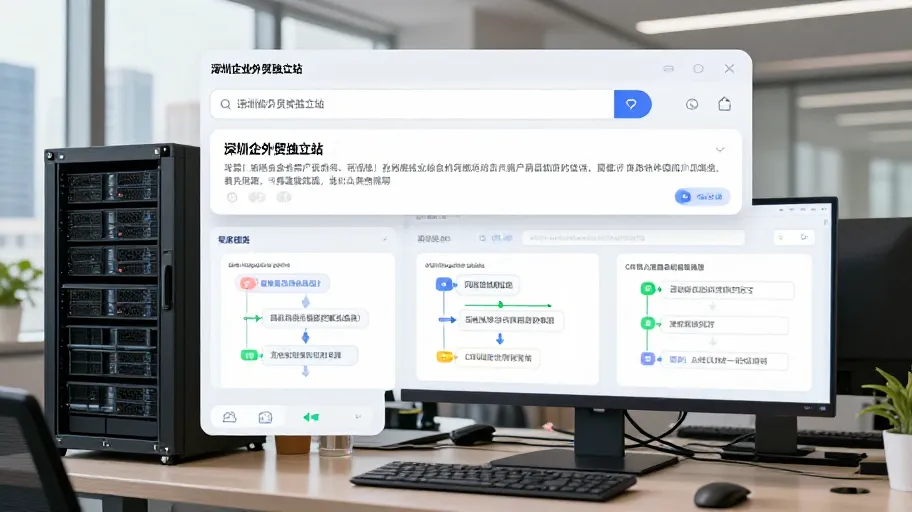
Direct Answer: For Shenzhen enterprises pursuing AI search optimization, the real challenge isn't about "how much content you publish," but rather integrating three key data pipelines: search-side data (how users query in AI search), website-side data (how your independent site is understood and presented), and lead-side data (which inquiries in your CRM actually convert into orders). If these three data streams remain isolated, even if your business appears in AI search results, it will be difficult to turn visibility into actual sales. This article provides a decision-making framework and an execution checklist to help you assess where you're stuck.

A Shenzhen factory’s official website shouldn’t be just an “electronic business card”; it should serve as a digital production-line entry point capable of accepting orders, verifying goods, passing inspections, and connecting to MES systems. This article exposes five common real-world pitfalls, dissecting local cases like Foxconn and Dazhong Laser: how to transform your website into a B2B conversion engine that cuts costs by 37% and accelerates inquiry responses by 2.8 times.

When Shenzhen enterprises revamp their websites, it’s not about changing the exterior—it’s about resetting the lifeline of customer acquisition. Without proactively scanning traffic baselines, conversion funnels, and system interfaces, 92% will face a drop of over 40% in organic traffic within 30 days (SE Ranking 2025). This isn’t a technical checklist—it’s a commercial red line for preventing losses.

Is your Shenzhen business website stuck on the second page of SEO results? It’s not due to insufficient keywords—it’s because search engines simply don’t recognize you as a “local Shenzhen service provider”—missing structured data, blank semantic clusters, and unresolved technical debts are costing you 37% of high-intent leads every day. This article provides actionable steps for a successful website overhaul.
Building a Shenzhen foreign trade independent site isn’t about creating a website—it’s about constructing a digital trade hub capable of scaling customer acquisition. This article uses real-life cases, verifiable data, and phased validation paths to help you avoid the trap of 92% of enterprises having a first-year conversion rate below 1.8%.


Shenzhen foreign trade professionals stare daily at their independent site dashboards, watching helplessly as 92% of high-intent inquiries disappear within four hours. This isn’t a traffic issue—it’s a mismatch in response rhythm. This article breaks down an auditable, deliverable automation system that avoids touching core ERP systems—it compresses first contact time to 85 seconds, eliminates quoting errors, and brings sales back to the negotiating table.

