
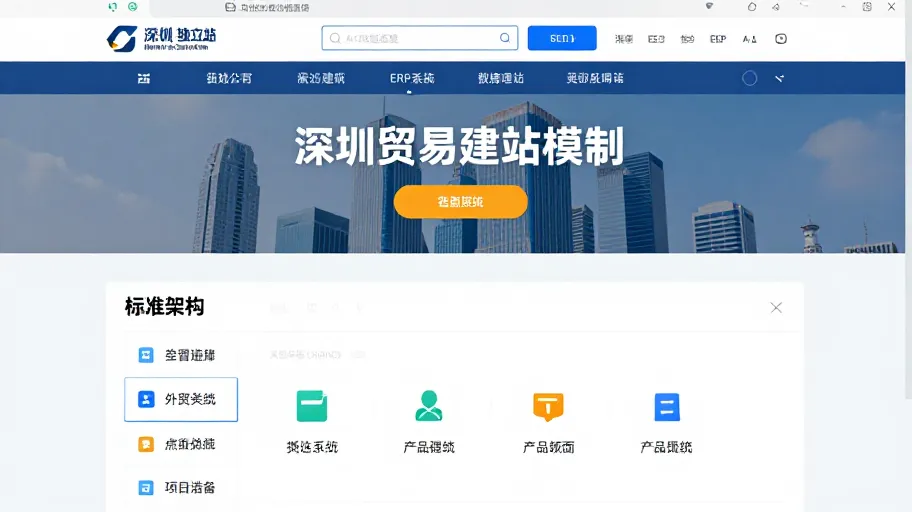
When Shenzhen-based manufacturing and foreign trade enterprises face stagnation in lead conversion rates, slow loading of multilingual markets, or inability to integrate core business systems, it is a clear signal that they should upgrade from standard website building to customized Shenzhen independent sites. Standard templates can solve the problem of launching a website from scratch, but as business complexity increases, fixed frameworks gradually consume growth budgets. The core of custom implementation lies not in visual redesign, but in reshaping underlying data flows, SEO architecture, and customer management workflows to fully align with the enterprise's own trade processes.

In the fiercely competitive Shenzhen market, template-based websites can no longer sustain brand growth. Truly effective Shenzhen website development transforms brand strategy into an executable digital experience. Here are the key pathways for businesses to achieve efficient conversions.

90% of website visitors quietly slip away after submitting their information—not because they don't want to buy, but because you haven't yet had the chance to respond. AI CRM is rewriting this rule, turning every click into a sales opportunity through real-time behavior recognition and automated workflows.
Before customers even speak, the system is already prepared with solutions—this isn’t science fiction. AI-powered customer relationship management is turning service from a cost center into a growth engine through real-time insights and self-learning architectures. Let’s see how it works.

In today’s world where traffic is getting increasingly expensive, high-end website construction is no longer just a ‘nice-to-have’ feature. It determines whether your customer acquisition costs drop by 40% or rise by 20% every year. We break down the three key things Shenzhen brands should really focus on: technical architecture, data assets, and ROI calculation.

When keyboard rhythm, gaze duration, and even microexpressions become programming optimization signals, Vibe Coding is redefining the efficient programming experience. This isn’t science fiction—it’s a development paradigm already in practice.
Traditional CRM can only record the past, while AI-driven systems can predict the future. We’ve seen companies use dynamic customer profiles and automated intervention mechanisms to boost lead conversion efficiency by more than an order of magnitude. The key isn’t whether to adopt AI, but where to start seeing results.

Shenzhen businesses have been doing SEO for years but still see no improvement? The problem isn’t effort—it’s direction. True website optimization is no longer about backlinks; it’s a digital projection of local market insights. See how the pros do it.

Traditional independent sites are trapped in the vicious cycle of “traffic without conversion.” GEO independent sites, through semantic understanding, edge acceleration, and closed-loop data systems, ensure brands are seen, understood, and retained by the right audience. This isn’t just a website upgrade—it’s a fundamental reshaping of growth logic.
Over 60% of website leads are lost before entering the CRM. For every additional 5 minutes of response delay, conversion probability drops tenfold. AI CRM is transforming passive record-keeping into proactive lead capture through behavioral tracking and intelligent allocation.

The core of a GEO independent site lies in integrating generative engine optimization (GEO), AI CRM customer lead management, and the proprietary customer acquisition system of an e-commerce independent site, forming a business closed loop that spans from content discovery and lead identification to continuous customer nurturing. For manufacturing and foreign trade enterprises in Shenzhen and the Greater Bay Area, this means no longer relying on single search clicks; instead, independent site content directly connects with the enterprise's customer management backend in the AI search era, turning every content exposure into a traceable, operable proprietary asset. When evaluating this system, companies should focus not on isolated website-building features but on whether the "content presentation - lead accumulation - continuous outreach" chain operates smoothly.

